
Production-grade memory infrastructure for multi-agent systems. Namespace isolation, RBAC, provenance, ranked retrieval.
Verified details
These details have been verified by PyPIProject links
GitHub Statistics
Maintainers

Project description

Production-grade memory infrastructure for multi-agent systems.




The Problem
Agent systems lose state the moment a session ends. Single agents rediscover the same facts every run. Multi-agent pipelines are worse — the planner's decisions never reach the executor, the researcher's findings never reach the reviewer, and teams end up stuffing giant prompts between agents to paper over the gap.
Most memory "solutions" are either flat files loaded wholesale into context, or SaaS endpoints with opaque ranking and per-seat pricing. Neither is something you ship to production.
Memwright is the memory tier for agent systems that need to run in production — with ranked retrieval, namespace isolation, RBAC, provenance, and contradiction handling built in.
What Memwright Delivers
- Multi-agent ready — namespace isolation, 6 RBAC roles, per-agent write quotas, token budgets, provenance tracking, inter-agent scratchpad
- Ranked retrieval — 5-layer pipeline (graph expansion → tag match → entity search → vector similarity → relation triples) with RRF fusion, PageRank boosting, and MMR diversity
- Token-budget recall — set a ceiling; Memwright fits the highest-scoring memories within it
- Temporal correctness — automatic contradiction detection, supersession, validity windows, and timeline reconstruction per entity
- Production deploy paths — ship as a Python library, a REST API, or a containerized service on AWS, Azure, or GCP
- Pluggable backends — SQLite/ChromaDB/NetworkX locally; PostgreSQL+pgvector+AGE, ArangoDB, Cosmos DB, or AlloyDB in production
Table of Contents
- Quick Start
- Architecture
- Multi-Agent Systems
- How It Works
- Retrieval Pipeline
- Python API
- REST API
- MCP Integration
- Cloud Backends
- Cloud Deployment
- Embedding Providers
- CLI Reference
- Configuration
- Testing
- Benchmarks
- Compatibility
- Uninstall
Quick Start
Python (library)
poetry add memwright
from agent_memory import AgentMemory

mem = AgentMemory("./store")
mem.add("Architecture decision: event sourcing for order service",
        category="technical", entity="order-service", tags=["arch", "decision"])
results = mem.recall("how is the order service structured?", budget=2000)
REST API — self-host in one command
pip install memwright
memwright api --host 0.0.0.0 --port 8080
That's it. Starlette ASGI on http://localhost:8080. SQLite + ChromaDB + NetworkX provision automatically under ~/.memwright. No Docker, no API keys, no cloud account. Point every agent in your stack at the same URL — they share memory instantly. Air-gap it behind your firewall and walk away.
# smoke test
curl -X POST http://localhost:8080/add \
  -H "Content-Type: application/json" \
  -d '{"content":"test","category":"note"}'

curl -X POST http://localhost:8080/recall \
  -H "Content-Type: application/json" \
  -d '{"query":"test","budget":1000}'
Same command deploys to AWS App Runner, GCP Cloud Run, or Azure Container Apps — see Cloud Deployment.
MCP Integration (any MCP-compatible client)
{
  "mcpServers": {
    "memory": {
      "command": "memwright",
      "args": ["mcp"]
    }
  }
}
Works with Claude Code, Cursor, Windsurf, and any stdio-based MCP client.
Verify
memwright doctor ~/.memwright
All four checks should return healthy: Document Store, Vector Store, Graph Store, Retrieval Pipeline.
Architecture
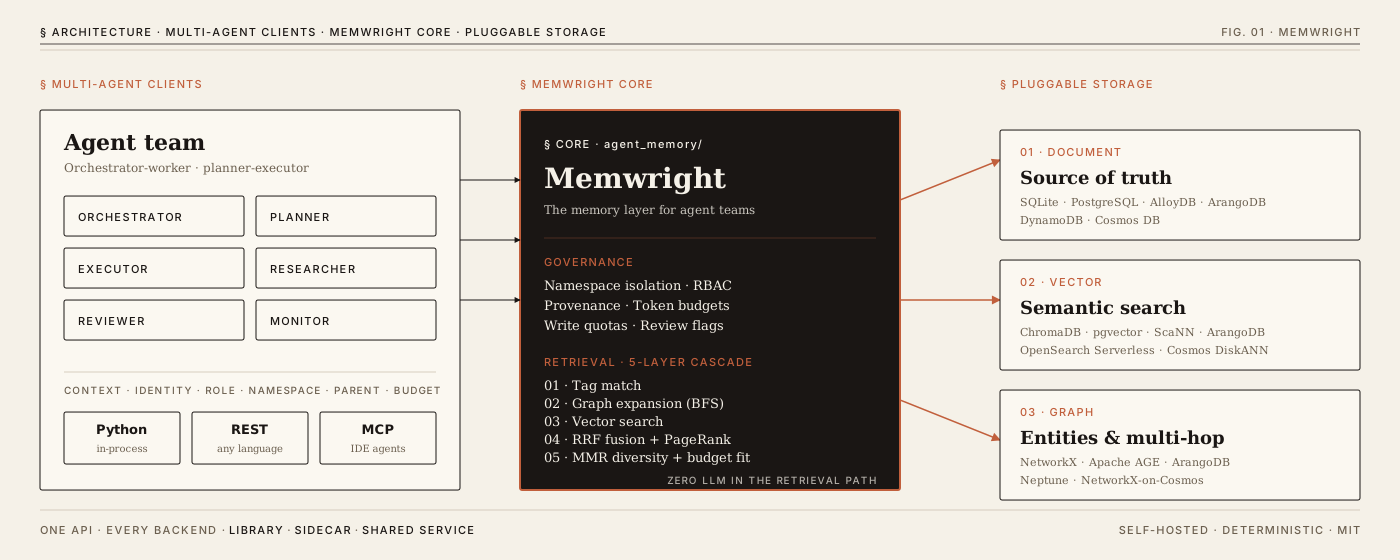
Component Overview
agent_memory/
├── core.py                    # AgentMemory — main orchestrator
├── models.py                  # Memory + RetrievalResult dataclasses
├── context.py                 # AgentContext — multi-agent provenance & RBAC
├── client.py                  # MemoryClient — HTTP client for distributed mode
├── cli.py                     # CLI entry point (19 commands)
├── api.py                     # Starlette ASGI REST API (8 routes)
├── store/
│   ├── base.py                # Abstract interfaces: DocumentStore, VectorStore, GraphStore
│   ├── sqlite_store.py        # SQLite storage (WAL, 17 columns, 8 indexes)
│   ├── chroma_store.py        # ChromaDB vector search (local sentence-transformers)
│   ├── schema.sql             # SQLite schema definition
│   ├── postgres_backend.py    # PostgreSQL (pgvector + Apache AGE)
│   ├── arango_backend.py      # ArangoDB (native doc + vector + graph)
│   ├── aws_backend.py         # AWS (DynamoDB + OpenSearch + Neptune)
│   └── azure_backend.py       # Azure (Cosmos DB DiskANN + NetworkX)
├── graph/
│   ├── networkx_graph.py      # NetworkX MultiDiGraph with PageRank + BFS
│   └── extractor.py           # Entity/relation extraction (50+ known tools)
├── retrieval/
│   ├── orchestrator.py        # 3-layer cascade with RRF fusion
│   ├── tag_matcher.py         # Stop-word filtered tag extraction
│   └── scorer.py              # Temporal, entity, PageRank, MMR, confidence decay
├── temporal/
│   └── manager.py             # Contradiction detection + supersession
├── extraction/
│   └── extractor.py           # Rule-based + LLM memory extraction
├── mcp/
│   └── server.py              # MCP server (8 tools, 2 resources, 2 prompts)
├── hooks/
│   ├── session_start.py       # Context injection (20K token budget)
│   ├── post_tool_use.py       # Auto-capture from Write/Edit/Bash
│   └── stop.py                # Session summary generation
├── utils/
│   └── config.py              # MemoryConfig dataclass + load/save
└── infra/                     # Terraform + Docker for cloud deployments
    ├── apprunner/             # AWS App Runner
    ├── cloudrun/              # GCP Cloud Run
    └── containerapp/          # Azure Container Apps
Three Storage Roles
Every backend implements one or more of these roles:
| Role | Purpose | Local Default | Cloud Options |
|---|---|---|---|
| Document | Core storage, CRUD, filtering | SQLite | PostgreSQL, ArangoDB, DynamoDB, Cosmos DB |
| Vector | Semantic similarity search | ChromaDB | pgvector, ArangoDB, OpenSearch, Cosmos DiskANN |
| Graph | Entity relationships, BFS traversal | NetworkX | Apache AGE, ArangoDB, Neptune |
Cloud backends fill all 3 roles in a single service. If any optional component fails, the system degrades gracefully to document-only.
How It Works
Memory is infrastructure, not a prompt attachment
Memwright runs as a separate tier — a library, a container, or a cloud service — that agents query on demand. Stored memories never enter the context window until an agent explicitly calls recall() with a token budget. Retrieval cost stays constant as the store grows from 100 to 5,000,000 memories; only the ranking candidate pool expands.
Token cost is bounded by budget, not store size
Naive context-injection approach:
  Month 1:   2K tokens loaded every message
  Month 6:  15K tokens loaded every message  ← context crowded

Memwright:
  Month 1:   ≤2K tokens returned per recall  (ranked from 100 memories)
  Month 6:   ≤2K tokens returned per recall  (ranked from 5,000 memories)
                                             ← bounded cost, deeper recall
How a recall works
When an agent calls memory_recall("deployment setup", budget=2000):
Store: 5,000 memories

  Tag search finds:     15 memories tagged "deployment"
  Graph search finds:    8 memories linked to "AWS", "Docker" entities
  Vector search finds:  20 semantically similar memories

  After dedup + RRF fusion:  30 unique candidates, scored and ranked

  Budget fitting (2,000 tokens):
    Memory A (score 0.95):  500 tokens → in   (total: 500)
    Memory B (score 0.90):  600 tokens → in   (total: 1,100)
    Memory C (score 0.88):  400 tokens → in   (total: 1,500)
    Memory D (score 0.85):  300 tokens → in   (total: 1,800)
    Memory E (score 0.80):  400 tokens → SKIP (exceeds 2,000)

  Result: 4 memories, 1,800 tokens. 4,996 memories never entered context.
MCP Integration
Memwright ships an MCP server so any MCP-compatible client (Claude Code, Cursor, Windsurf, custom agents) can store and retrieve memories. Start it with memwright mcp.
| Tool | Purpose | Key Parameters |
|---|---|---|
memory_add |
Store a fact | content, tags[], category, entity, namespace, event_date, confidence |
memory_recall |
Smart multi-layer retrieval | query, budget (default: 2000), namespace |
memory_search |
Filter with date ranges | query, category, entity, namespace, status, after, before, limit |
memory_get |
Fetch by ID | memory_id |
memory_forget |
Archive (soft delete) | memory_id |
memory_timeline |
Chronological entity history | entity, namespace |
memory_stats |
Store size, counts | — |
memory_health |
Health check (call first!) | — |
Categories
core_belief · preference · career · project · technical · personal · location · relationship · event · session · general
MCP Resources
memwright://entity/{name}— Entity details + related entities from graphmemwright://memory/{id}— Full memory object
MCP Prompts
recall— Search memories for relevant contexttimeline— Chronological history of an entity
Retrieval Pipeline
The retrieval system uses a 5-layer cascade with multi-signal fusion:
Query: "deployment setup"
  │
  ├─ Layer 0: Graph Expansion
  │  Extract entities from query → BFS traversal (depth=2)
  │  "deployment" → finds "AWS", "Docker", "Terraform" connections
  │
  ├─ Layer 1: Tag Match (SQLite)
  │  extract_tags(query) → tag_search() → score 1.0
  │
  ├─ Layer 2: Entity-Field Search
  │  Memories about graph-connected entities → score 0.5
  │
  ├─ Layer 3: Vector Search (ChromaDB)
  │  Semantic similarity → score = 1 - cosine_distance
  │
  ├─ Layer 4: Graph Relation Triples
  │  Inject relationship context → score 0.6
  │
  ▼ FUSION
  ├─ Reciprocal Rank Fusion (RRF, k=60)
  │  score = Σ 1/(k + rank_in_source)
  │  OR Graph Blend: 0.7 * norm_vector + 0.3 * norm_pagerank
  │
  ▼ SCORING
  ├─ Temporal Boost: +0.2 * max(0, 1 - age_days/90)
  ├─ Entity Boost:   +0.30 exact match, +0.15 substring
  ├─ PageRank Boost:  +0.3 * entity_pagerank_score
  │
  ▼ DIVERSITY
  ├─ MMR Rerank: λ*relevance - (1-λ)*max_jaccard_similarity (λ=0.7)
  │
  ▼ CONFIDENCE
  ├─ Time Decay:    -0.001 per hour since last access
  ├─ Access Boost:  +0.03 per access_count
  ├─ Clamp:         [0.1, 1.0]
  │
  ▼ BUDGET
  └─ Greedy selection by score until token budget filled
Querying "Python" also finds memories about "FastAPI" if they're connected in the entity graph. Multi-hop reasoning through relationship traversal.
Python API
Basic Usage
from agent_memory import AgentMemory

mem = AgentMemory("./my-agent")  # auto-provisions all backends

# Store
mem.add("User prefers Python over Java",
        tags=["preference", "coding"],
        category="preference",
        entity="Python")

# Recall with token budget
results = mem.recall("what language?", budget=2000)

# Formatted context for prompt injection
context = mem.recall_as_context("user background", budget=4000)

# Search with filters
memories = mem.search(category="project", entity="Python", limit=10)

# Timeline
history = mem.timeline("Python")

# Contradiction handling — automatic
mem.add("User works at Google", tags=["career"], category="career", entity="Google")
mem.add("User works at Meta", tags=["career"], category="career", entity="Meta")
# ^ Google memory auto-superseded

# Namespace isolation
mem.add("Team standup at 9am", namespace="team:alpha")
results = mem.recall("standup time", namespace="team:alpha")

# Maintenance
mem.forget(memory_id)             # Archive
mem.forget_before("2025-01-01")   # Archive old memories
mem.compact()                     # Permanently delete archived
mem.export_json("backup.json")    # Export
mem.import_json("backup.json")    # Import (dedup by content hash)

# Health & stats
mem.health()  # → {sqlite: ok, chroma: ok, networkx: ok, retrieval: ok}
mem.stats()   # → {total: 500, active: 480, ...}

# Context manager
with AgentMemory("./store") as mem:
    mem.add("auto-closed on exit")
Memory Object
@dataclass
class Memory:
    id: str                    # UUID
    content: str               # The actual fact/observation
    tags: List[str]            # Searchable tags
    category: str              # Classification (preference, career, project, ...)
    entity: str                # Primary entity (company, tool, person)
    namespace: str             # Isolation key (default: "default")
    created_at: str            # ISO timestamp
    event_date: str            # When the fact occurred
    valid_from: str            # Temporal validity start
    valid_until: str           # Set when superseded
    superseded_by: str         # ID of replacement memory
    confidence: float          # 0.0-1.0
    status: str                # active | superseded | archived
    access_count: int          # Times recalled
    last_accessed: str         # Last recall timestamp
    content_hash: str          # SHA-256 for dedup
    metadata: Dict[str, Any]   # Arbitrary JSON
Multi-Agent Systems
Memwright is built for production multi-agent pipelines — orchestrator-worker, planner-executor, researcher-reviewer, and hierarchical swarms. Every recall and write is scoped to an AgentContext that carries identity, role, namespace, parent trail, token budget, write quota, and visibility policy. Contexts are immutable; spawning a sub-agent returns a new context with inherited provenance.
from agent_memory.context import AgentContext, AgentRole, Visibility

# Create a root context
ctx = AgentContext.from_env(
    agent_id="orchestrator",
    namespace="project:acme",
    role=AgentRole.ORCHESTRATOR,
    token_budget=20000,
)

# Spawn child contexts for sub-agents (immutable — returns new instance)
planner = ctx.as_agent("planner", role=AgentRole.PLANNER, token_budget=5000)
researcher = ctx.as_agent("researcher", role=AgentRole.RESEARCHER, read_only=True)

# Provenance tracking — metadata auto-enriched
planner.add_memory("Architecture decision: use event sourcing",
                   category="technical", visibility=Visibility.TEAM)
# metadata includes: _agent_id, _session_id, _namespace, _visibility, _role

# Recall is scoped to namespace + cached within session
results = researcher.recall("architecture decisions")

# Token budget tracked
print(researcher.token_budget - researcher.token_budget_used)

# Governance
researcher.flag_for_review("Need human approval for deployment plan")
researcher.add_compliance_tag("SOC2")

# Session introspection
summary = ctx.session_summary()
# → {agent_trail, memories_written, memories_recalled, token_usage, review_flags}
AgentContext Features
| Feature | Description |
|---|---|
| Namespace isolation | Each agent/project gets isolated memory partition |
| RBAC roles | ORCHESTRATOR, PLANNER, EXECUTOR, RESEARCHER, REVIEWER, MONITOR |
| Read-only mode | Agents can recall but not write |
| Write quotas | max_writes_per_agent (default: 100) |
| Token budgets | Per-agent budget tracking |
| Recall cache | Dedup redundant queries within a session |
| Scratchpad | Inter-agent data passing |
| Provenance | Agent trail, parent tracking, visibility levels |
| Compliance | Review flags, compliance tags for audit |
| Distributed mode | Set memory_url to use HTTP client instead of local |
Cloud Backends
Each cloud backend fills all three roles (document, vector, graph) in a single service:
PostgreSQL (Neon, Cloud SQL, self-hosted)
Uses pgvector for vectors, Apache AGE for graph. AGE is optional — without it, graph gracefully degrades.
mem = AgentMemory("./store", config={
    "backends": ["postgres"],
    "postgres": {"url": "postgresql://user:pass@host:5432/memwright"}
})
ArangoDB (ArangoGraph Cloud, Docker)
Native document, vector, and graph support in one database.
mem = AgentMemory("./store", config={
    "backends": ["arangodb"],
    "arangodb": {"url": "https://instance.arangodb.cloud:8529", "database": "memwright"}
})
Azure (Cosmos DB)
Cosmos DB with DiskANN vector indexing. Graph via NetworkX persisted to Cosmos containers.
mem = AgentMemory("./store", config={
    "backends": ["azure"],
    "azure": {"cosmos_endpoint": "https://account.documents.azure.com:443/"}
})
GCP (AlloyDB)
Extends PostgreSQL backend with AlloyDB Connector (IAM auth) and Vertex AI embeddings (768D).
mem = AgentMemory("./store", config={
    "backends": ["gcp"],
    "gcp": {"project_id": "my-project", "cluster": "memwright", "instance": "primary"}
})
Installing cloud extras
poetry add "memwright[postgres]"    # PostgreSQL
poetry add "memwright[arangodb]"    # ArangoDB
poetry add "memwright[aws]"         # AWS (DynamoDB + OpenSearch + Neptune)
poetry add "memwright[azure]"       # Azure Cosmos DB
poetry add "memwright[gcp]"         # GCP AlloyDB + Vertex AI
poetry add "memwright[all]"         # Everything
Cloud Deployment
Deploy Memwright as an HTTP API on any cloud with a single command:
./scripts/deploy.sh aws        # App Runner (2 CPU / 4GB, auto-scale)
./scripts/deploy.sh gcp        # Cloud Run (auto-scale 0–3, 2 CPU / 4GB)
./scripts/deploy.sh azure      # Container Apps (scale-to-zero, 2 CPU / 4GB)

./scripts/deploy.sh aws --teardown   # Destroy everything
Prerequisites: Docker, Terraform, cloud CLI (aws/gcloud/az), backend credentials in .env.
| Cloud | Infrastructure | Terraform |
|---|---|---|
| AWS | ECR + App Runner (2 CPU, 4GB) | agent_memory/infra/apprunner/main.tf |
| GCP | Artifact Registry + Cloud Run (2 CPU, 4GB) | agent_memory/infra/cloudrun/main.tf |
| Azure | ACR + Log Analytics + Container Apps (2 CPU, 4GB) | agent_memory/infra/containerapp/main.tf |
REST API Endpoints
All deployments expose the same Starlette ASGI API:
| Method | Endpoint | Description |
|---|---|---|
GET |
/health |
Component health check |
GET |
/stats |
Store statistics |
POST |
/add |
Add a memory |
POST |
/recall |
Smart retrieval with budget |
POST |
/search |
Filtered search |
POST |
/timeline |
Entity chronological history |
POST |
/forget |
Archive a memory |
GET |
/memory/{id} |
Get memory by ID |
Response envelope: {"ok": true, "data": {...}} or {"ok": false, "error": "message"}
Embedding Providers
Memwright auto-detects the best available embedding provider:
| Priority | Provider | Model | Dimensions | Trigger |
|---|---|---|---|---|
| 1 | Cloud-native | Bedrock Titan / Azure OpenAI / Vertex AI | 768-1536 | Cloud backend configured |
| 2 | OpenAI / OpenRouter | text-embedding-3-small | 1536 | OPENAI_API_KEY or OPENROUTER_API_KEY set |
| 3 | Local (default) | all-MiniLM-L6-v2 | 384 | Always available, no API key |
The local fallback downloads ~90MB on first use. All providers implement the same interface — switching is transparent.
CLI Reference
Both memwright and agent-memory work as entry points:
MCP Server
memwright mcp                          # Start MCP server (uses ~/.memwright)
memwright mcp --path /custom/path      # Custom store location
Memory Operations
agent-memory add ./store "User prefers Python" --tags "pref,coding" --category preference
agent-memory recall ./store "what language?" --budget 4000
agent-memory search ./store --category project --entity Python --limit 20
agent-memory list ./store --status active --category technical
agent-memory timeline ./store --entity Python
agent-memory get ./store <memory-id>
agent-memory forget ./store <memory-id>
Maintenance
agent-memory doctor ~/.memwright       # Health check (SQLite, ChromaDB, NetworkX, Retrieval)
agent-memory stats ./store             # Memory counts, DB size, breakdowns
agent-memory export ./store -o backup.json
agent-memory import ./store backup.json
agent-memory compact ./store           # Permanently delete archived memories
agent-memory inspect ./store           # Raw DB inspection
Lifecycle Hooks
memwright hook session-start           # Inject context at agent session start
memwright hook post-tool-use           # Auto-capture tool observations
memwright hook stop                    # Generate session summary on exit
Hooks integrate with any harness that supports session lifecycle callbacks.
Benchmarks
agent-memory locomo --max-conversations 5 --verbose
agent-memory mab --categories AR,CR --max-examples 10
Configuration
Store location
Default: ~/.memwright/. Configurable with --path on any CLI command.
~/.memwright/
├── memory.db        # SQLite database (core storage)
├── config.json      # Retrieval tuning parameters
├── graph.json       # NetworkX entity graph
└── chroma/          # ChromaDB vector store + embeddings
config.json
All fields optional. Defaults apply if the file doesn't exist:
{
  "default_token_budget": 2000,
  "min_results": 3,
  "backends": ["sqlite", "chroma", "networkx"],
  "enable_mmr": true,
  "mmr_lambda": 0.7,
  "fusion_mode": "rrf",
  "confidence_gate": 0.0,
  "confidence_decay_rate": 0.001,
  "confidence_boost_rate": 0.03
}
| Parameter | Default | Description |
|---|---|---|
default_token_budget |
2000 | Max tokens returned per recall |
min_results |
3 | Minimum results to return |
enable_mmr |
true | Maximal Marginal Relevance diversity reranking |
mmr_lambda |
0.7 | Relevance vs diversity balance (0=diverse, 1=relevant) |
fusion_mode |
"rrf" | "rrf" (parameter-free) or "graph_blend" (weighted) |
confidence_decay_rate |
0.001 | Score penalty per hour since last access |
confidence_boost_rate |
0.03 | Score boost per access count |
confidence_gate |
0.0 | Minimum confidence threshold to include in results |
Environment Variables
| Variable | Purpose |
|---|---|
MEMWRIGHT_PATH |
Default store path |
MEMWRIGHT_URL |
Remote API URL (distributed mode) |
MEMWRIGHT_NAMESPACE |
Default namespace |
MEMWRIGHT_TOKEN_BUDGET |
Default token budget |
MEMWRIGHT_SESSION_ID |
Session ID for provenance tracking |
Testing
Running Tests
# All unit tests — no Docker, no API keys
poetry run pytest tests/ -v

# With coverage
poetry run pytest tests/ -v --cov=agent_memory --cov-report=term-missing

# Live integration tests (need credentials)
NEON_DATABASE_URL='postgresql://...' poetry run pytest tests/test_postgres_live.py -v
AZURE_COSMOS_ENDPOINT='https://...' poetry run pytest tests/test_azure_live.py -v
Test Coverage
- 607 unit tests covering all backends, retrieval, config, embeddings, and CLI
- 14 live integration tests per cloud backend (Neon, Azure, ArangoDB)
- Mock tests for every cloud backend — no cloud account needed
- All unit tests run without Docker or API keys
Benchmarks
Latency (P50 recall — the core operation)
| Backend | Stack | P50 | P95 | P99 |
|---|---|---|---|---|
| PG + pgvector + AGE (Docker) | PostgreSQL 16 + pgvector + Apache AGE | 1.4ms | 5.5ms | 39ms |
| SQLite + ChromaDB + NetworkX (local) | SQLite 3 + ChromaDB 1.x + NetworkX 3 | 9.1ms | 31ms | 75ms |
| ArangoDB (Docker) | ArangoDB 3.12 (doc + vector + graph) | 40ms | 57ms | 68ms |
| GCP Cloud Run (us-central1) | Starlette + Uvicorn → ArangoDB Oasis | 156ms | 245ms | 271ms |
| Azure Container Apps (eastus) | Starlette + Uvicorn → ArangoDB Oasis | 293ms | 466ms | 480ms |
| AWS App Runner (us-west-2) | Starlette + Uvicorn → ArangoDB Oasis | 621ms | 792ms | 813ms |
vs. Competitors (recall P50)
| System | Stack | P50 | Notes |
|---|---|---|---|
| Memwright (PG Docker) | PG 16 + pgvector + AGE | 1.4ms | Full 3-layer pipeline, 81.2% LOCOMO |
| Ruflo | In-process HNSW | 2-3ms | Vector lookup only, not full retrieval |
| Memwright (local) | SQLite + ChromaDB + NX | 9.1ms | Embedded, no Docker, no API keys |
| Memwright (GCP Cloud Run) | Starlette → ArangoDB Oasis | 156ms | Full cloud API, scale-to-zero |
| Mem0 | Cloud + LLM judge | 200ms | LLM in retrieval path |
| Zep | Neo4j + embeddings | <200ms | P95 ~632ms under concurrency |
| Mem0 Graph | Cloud + LLM + graph | 660ms | Graph variant, much slower |
Full methodology, per-backend add/search latency, and reproduction scripts live in the repository under benchmarks/.
LOCOMO (Long Conversation Memory)
| System | Accuracy |
|---|---|
| MemMachine | 84.9% |
| Memwright | 81.2% |
| Zep | ~75% |
| Letta | 74.0% |
| Mem0 (Graph) | 66.9% |
| OpenAI Memory | 52.9% |
Scores are self-reported across vendors. Methodology is disputed.
Retrieval is fully local — tag matching, graph traversal, vector search with RRF fusion. No LLM re-ranking. Only benchmark answer synthesis uses an LLM.
Compatibility
MCP Clients
| Client | Config File |
|---|---|
| Any MCP client | Standard MCP stdio transport |
| Claude Code | .mcp.json (project) or ~/.claude/.mcp.json (global) |
| Cursor | .cursor/mcp.json |
| Windsurf | MCP config in settings |
Same memwright mcp command for every client.
Python
- Python 3.10, 3.11, 3.12, 3.13, 3.14
Uninstall
1. Remove MCP server config (if used)
Delete the memory entry from your MCP client's config file.
2. Uninstall the package
poetry remove memwright
3. Delete stored memories (optional)
# Export first if you want a backup
agent-memory export ~/.memwright -o memwright-backup.json

# Then delete
rm -rf ~/.memwright
License
Apache 2.0
mcp-name: io.github.bolnet/memwright
Project details
Verified details
These details have been verified by PyPIProject links
GitHub Statistics
Maintainers
Release history Release notifications | RSS feed


Download files
Download the file for your platform. If you're not sure which to choose, learn more about installing packages.
Source Distribution
Built Distribution
Filter files by name, interpreter, ABI, and platform.
If you're not sure about the file name format, learn more about wheel file names.
Copy a direct link to the current filters
File details
Details for the file memwright-2.0.6.tar.gz.
File metadata
- Download URL: memwright-2.0.6.tar.gz
- Upload date:
- Size: 122.2 kB
- Tags: Source
- Uploaded using Trusted Publishing? Yes
- Uploaded via: twine/6.1.0 CPython/3.13.12
File hashes
| Algorithm | Hash digest | |
|---|---|---|
| SHA256 |
63c98a1dbd6d9458060779063463082c9315f94138d0386c15bbf4e1bf1c10c2
|
|
| MD5 |
cb830bfebfd9a529694739dff3eb6721
|
|
| BLAKE2b-256 |
f370649d930ad80bbb7238e90664b78ccf3904c9438994ef121f5973c929bf30
|
Provenance
The following attestation bundles were made for memwright-2.0.6.tar.gz:
Publisher:
workflow.yml on bolnet/agent-memory
-
Statement:
-
Statement type:
https://in-toto.io/Statement/v1 -
Predicate type:
https://docs.pypi.org/attestations/publish/v1 -
Subject name:
memwright-2.0.6.tar.gz -
Subject digest:
63c98a1dbd6d9458060779063463082c9315f94138d0386c15bbf4e1bf1c10c2 - Sigstore transparency entry: 1296338810
- Sigstore integration time:
-
Permalink:
bolnet/agent-memory@a40438446694677b0466b3357d82840656a98d35 -
Branch / Tag:
refs/tags/v2.0.6 - Owner: https://github.com/bolnet
-
Access:
public
-
Token Issuer:
https://token.actions.githubusercontent.com -
Runner Environment:
github-hosted -
Publication workflow:
workflow.yml@a40438446694677b0466b3357d82840656a98d35 -
Trigger Event:
release
-
Statement type:
File details
Details for the file memwright-2.0.6-py3-none-any.whl.
File metadata
- Download URL: memwright-2.0.6-py3-none-any.whl
- Upload date:
- Size: 138.1 kB
- Tags: Python 3
- Uploaded using Trusted Publishing? Yes
- Uploaded via: twine/6.1.0 CPython/3.13.12
File hashes
| Algorithm | Hash digest | |
|---|---|---|
| SHA256 |
cbda751f319719704b81301f2a776ca9e14c3b5c8d61303694f6544928fad70b
|
|
| MD5 |
6c9fe884605d40e47eca1dc286569dee
|
|
| BLAKE2b-256 |
3400abdf543967d7cb97f655cecab3d0ba2f55480449c479bf3b7a6f66d46b29
|
Provenance
The following attestation bundles were made for memwright-2.0.6-py3-none-any.whl:
Publisher:
workflow.yml on bolnet/agent-memory
-
Statement:
-
Statement type:
https://in-toto.io/Statement/v1 -
Predicate type:
https://docs.pypi.org/attestations/publish/v1 -
Subject name:
memwright-2.0.6-py3-none-any.whl -
Subject digest:
cbda751f319719704b81301f2a776ca9e14c3b5c8d61303694f6544928fad70b - Sigstore transparency entry: 1296339194
- Sigstore integration time:
-
Permalink:
bolnet/agent-memory@a40438446694677b0466b3357d82840656a98d35 -
Branch / Tag:
refs/tags/v2.0.6 - Owner: https://github.com/bolnet
-
Access:
public
-
Token Issuer:
https://token.actions.githubusercontent.com -
Runner Environment:
github-hosted -
Publication workflow:
workflow.yml@a40438446694677b0466b3357d82840656a98d35 -
Trigger Event:
release
-
Statement type:






